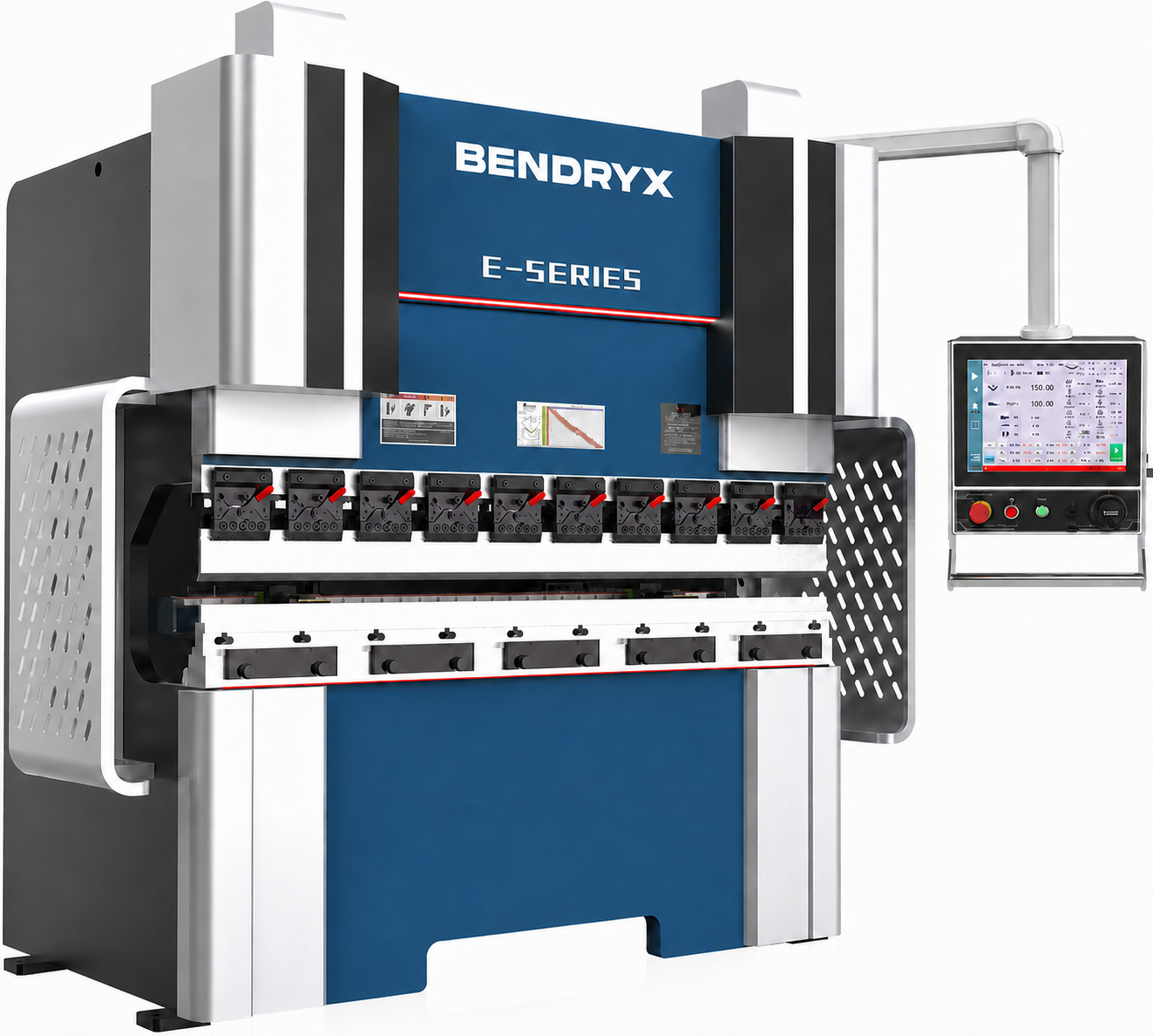
Drive architecture determines how the machine creates ram motion and forming force. The right choice depends on part size, required tonnage, working length, cycle expectations and operating priorities.
Full-electric servo architecture
An electric press brake drives the bending motion directly through servo motors and mechanical transmission. Power is applied when the axes move or form the part, and there is no hydraulic oil in the bending drive.
- Fast axis response for compact, high-mix work
- Low idle energy demand
- Clean operation without hydraulic oil
- Reduced hydraulic maintenance points
- Best fit in lower and medium force ranges
The BX-E025-0800 is a compact 25-ton, 800 mm example designed for precise small-part production.
Servo-hybrid hydraulic architecture
A servo-hybrid system uses servo control to manage hydraulic power according to the bending cycle. It retains hydraulic force capability while reducing constant pump operation, unnecessary heat and working noise.
- Broader tonnage and working-length range
- Efficient pressure and flow management
- Strong fit for general and heavy fabrication
- Available in single- and dual-servo arrangements
- Compatible with advanced crowning and gauging
The BX-SS-H130-3200 and BX-DS-H130-3200 both deliver 130-ton, 3,200 mm capability with different servo-hydraulic architectures.
Compare the practical differences.
| Decision factor | Full electric | Servo hybrid |
|---|---|---|
| Typical fit | Compact precision and high-mix work | General through heavy fabrication |
| Force range | Lower to medium | Broad, including high force |
| Working length | Compact to medium | Compact through long-bed systems |
| Energy behaviour | Power primarily during movement and forming | Servo-managed hydraulic demand |
| Hydraulic oil | Not used in bending drive | Required |
| Primary advantage | Response, cleanliness and efficiency | Force flexibility and broad application range |
Which architecture should you choose?
Choose based on the hardest real part and the expected production mix. A full-electric machine can be ideal when most work is small and precise. A servo hybrid is usually the stronger choice when force, long parts or application variety dominate.